Extended stable equilibrium invaded by
an unstable state: coexistence of states is an indispensable
feature in the observation of domain walls, interfaces,
shock waves or fronts in macroscopic systems. the propagation
of these nonlinear waves depends on the relative stability
of the connected equilibria. in particular, one expects
a stable equilibrium to invade an unstable one, such as
occur in combustion, in the spread of permanent contagious
diseases, or in the freezing of supercooled water. Here,
we show that an unstable state generically can invade
a locally stable one in the context of the pattern forming
systems. the origin of this phenomenon is related to the
lower energy unstable state invading the locally stable
but higher energy state. Based on a one-dimensional model
we reveal the necessary features to observe this phenomenon.
this scenario is fulfilled in the case of a first order
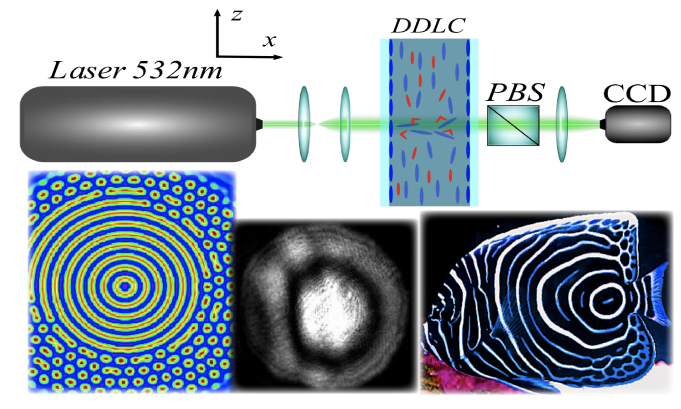
spatial instability. A photo-isomerization experiment
of a dye-dopant nematic liquid crystal, allow us to observe
the front propagation from an unstable state.
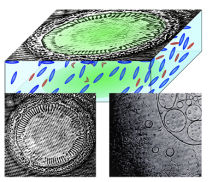
Umbilical defect dynamics:
Electrically driven nematic liquid crystals layers are
ideal contexts for studying the interactions of local
topological defects. Experimentally, we characterize
the coarsening dynamics in samples containing glass
beads as spacers and show that the inclusion of such
imperfections changes the exponent of the coarsening
law. Moreover, we demonstrate that beads that are slightly
deformed alter the surrounding molecular distribution
and attract vortices of both topological charges, thus,
presenting a mainly quadrupolar behavior. Theoretically,
based on a model of vortices diluted in a dipolar medium,
a 2/3 exponent is inferred, which is consistent with
the experimental observations.
Vortices nucleation
by inherent fluctuations in nematic liquid crystal cells:
The rhythms that govern the emergence of matter vortices
due to fluctuations are not established. We investigate
the nucleation mechanisms of the matter vortices in
liquid crystal cells and establish statistical laws
that govern them. Based on a stochastic amplitude equation,
the law for the number of nucleated vortices as a function
of anisotropy, voltage, and noise level intensity is
set. Experimental observations in a nematic liquid crystal
cell with homeotropic anchoring and a negative anisotropic
dielectric constant under a transversal electric field
strongly agree with the theoretical findings.
Topological transitions in an oscillatory
driven liquid crystal cell: Exotic states of matter,
such as Bose–Einstein condensates, superfluidity, chiral
magnets, superconductivity, and liquid crystalline blue
phases are observed in thermodynamic equilibrium. Rather
than being a result of an aggregation of matter, their
emergence is due to a change of a topological state of
the system. We investigate topological states of matter
in a system with injection and dissipation of energy by
means of oscillatory forcing. In an experiment involving
a liquid crystal cell under the influence of a low-frequency
oscillatory electric field, we observe a transition from
a non-vortex state to a state in which vortices persist,
topological transition. Depending on the period and the
type of the forcing, the vortices self-organise, forming
square lattices, glassy states, and disordered vortex
structures. The bifurcation diagram is characterised experimentally.
A continuous topological transition is observed for the
sawtooth and square forcings. The scenario changes dramatically
for sinusoidal forcing where the topological transition
is discontinuous, which is accompanied by serial transitions
between square and glassy vortex lattices. Based on a
stochastic amplitude equation, we recognise the origin
of the transition as the balance between stochastic creation
and deterministic annihilation of vortices. Numerical
simulations show topological transitions and the emergence
of square vortex lattice. Our results show that the matter
maintained out of equilibrium by means of the temporal
modulation of parameters can exhibit exotic states.
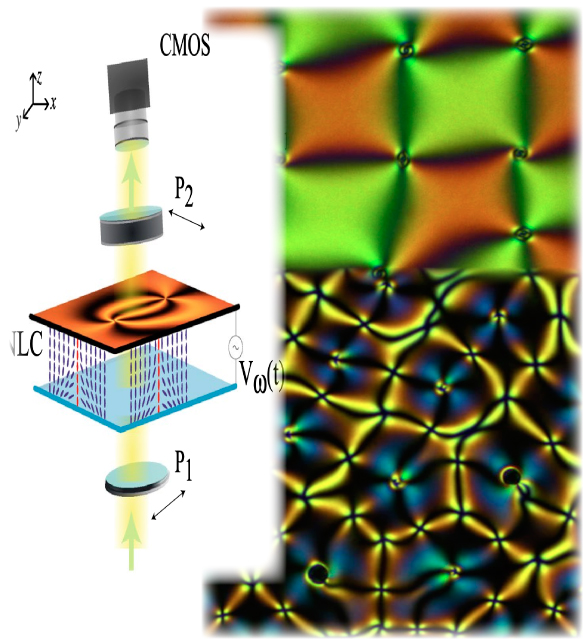
Magnetic field-induced vortex triplet and vortex
lattice in a liquid crystal cell: Vortices are particle-type
solutions with topological charges that can steer the
dynamics in various physical systems. By the application
of electromagnetic fields onto a homeotropic nematic
liquid crystal cell, we are able to induce a vortex
triplet that remains stable and trapped at a given location.
For a low frequency of the driven voltage, we observe
that the vortex triplet is unstable and gives rise to
the appearance of a topological lattice. Based on an
amplitude equation valid close to reorientational instability,
it allows us to reveal the origin of the vortex triplet
and vortex lattice. Numerical simulations show a quite
fair agreement with theoretical findings and experimental
observations.
Dancing vortices in a driven nematic liquid crystal
cell: Theory and experiment: The interaction of
light beams with helical defects in optical materials
generates optical vortices. Understanding and manipulating
the dynamics of helical defects allows for the creation
of versatile sources of optical vortex beams. Using
a magnetic ring on a nematic liquid crystal cell, we
trapped helical defects identified as matter vortices.We
observe oscillatory rotating and beating matter vortices
by applying a low-frequency voltage. Experimentally,
we determine the region of parameters where these vortices
are observed. The amplitude of oscillatory rotating
vortices decays with the inverse of the voltage frequency.We
propose an adequate amplitude equation, which allows
us to describe the vortex dynamics; theoretical findings
have a qualitative agreement with the experimental observations.
Spontaneous light-induced Turing patterns
in a dye-doped twisted nematic layer: Optical pattern
formation is usually due either to the combination of
diffraction and nonlinearity in a Kerr medium or to the
temporal modulation of light in a photosensitive chemical
reaction. Here, we show a different mechanism by which
light spontaneously induces stripe domains between nematic
states in a twisted nematic liquid crystal layer doped
with azo-dyes. Thanks to the photoisomerization process
of the dopants, light in the absorption band of the dopants
creates spontaneous patterns without the need of temporal
modulation, diffraction, Kerr or other optical nonlinearity,
but based on the different scales for dopant transport
processes and nematic order parameter, which identifies
a genuine Turing mechanism for this instability. Theoretically,
the emergence of the stripe patterns is described on the
basis of a model for the dopant concentration coupled
with the nematic order parameter.
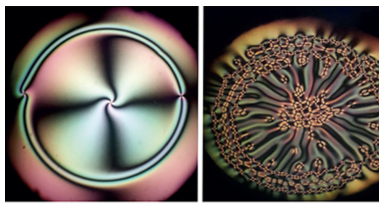
Localized dissipative vortices in chiral
nematic liquid crystal cells: Solitary waves and solitons
have played a fundamental role in understanding nonlinear
phenomena and emergent particle-type behaviors in out-of-equilibrium
systems. This type of dynamic phenomenon has not only
been essential to comprehend the behavior of fundamental
particles but also to establish the possibilities of novel
technologies based on optical elements. Dissipative vortices
are topological particle-type solutions in vectorial field
out-of-equilibrium systems. These states can be extended
or localized in space. The topological properties of these
states determine the existence, stability properties,
and dynamic evolution. Under homeotropic anchoring, chiral
nematic liquid crystal cells are a natural habitat for
localized vortices or spherulites. However, chiral bubble
creation and destruction mechanisms and their respective
bifurcation diagrams are unknown.We propose a minimal
two-dimensional model based on experimental observations
of a temperature-triggered first-order winding/unwinding
transition of a cholesteric liquid crystal cell and symmetry
arguments, and investigate this system experimentally.
This model reveals the main ingredients for the emergence
of chiral bubbles and their instabilities. Experimental
observations have a quite fair agreement with the theoretical
results. Our findings are a starting point to understand
the existence, stability, and dynamical behaviors of dissipative
particles with topological properties.
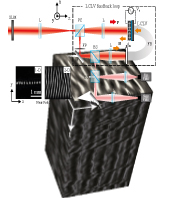
Extreme
events induced by spatiotemporal chaos in
experimental optical patterns. We
report on experimental results in the
physics of extreme events emerging in a
liquid-crystal light valve subjected to
optical feedback, and we establish the
relation of this phenomenon with the
appearance of spatiotemporal chaos. This
system, under particular conditions,
exhibits stationary roll patterns that can
be destabilized into quasi-periodic and
chaotic textures when control parameters are
properly modified. We have identified the
parameter regions where extreme fluctuations
of the amplitude can emerge and established
their origin through its direct relation
with the experimental largest Lyapunov
exponents, the proportion of extreme events,
and the normed kurtosis
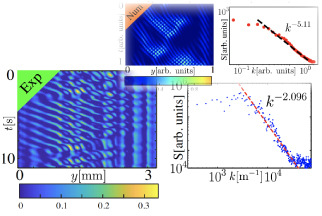
Transition to Spatiotemporal
Intermittency and Defect Turbulence in
Systems under Translational Coupling:
Out
of equilibrium systems under the influence
of enough energy injection exhibit complex
spatiotemporal behaviors. Based on a
liquid crystal light valve experiment with
translational optical feedback, we observe
propagation, spatiotemporal intermittency,
and defect turbulence of striped waves. A
prototype model of pattern formation with
translational coupling shows the same
phenomenology. Close to the spatial
instability, a local amplitude equation is
derived. This amplitude equation allows us
to reveal the origin and bifurcation
diagram of the observed complex
spatiotemporal dynamics. Experimental
observations have a qualitative agreement
with theoretical findings.
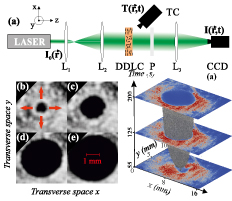
Photo-isomerization fronts
in dye-doped nematic liquid crystals: Photo-isomerization dynamics
in dye-doped nematic crystals sample is studied, which
shows that, when the sample is illuminated by a Gaussian
beam, and for high enough input power, a transition
from the nematic to the isotropic phase takes place
in the illuminated area. The two phases are spatially
connected via a front propagating outward from the center
of the beam and following the local intensity profile
and thus inducing a photo-controlled optical aperture.
The optical intensity and temperature fields on the
sample follow the same dynamical profile. The front
dynamics is described by a phenomenological bi-stable
model with an inhomogeneous control parameter, directly
related to the beam intensity profile.
Light
beam induced finger instability in a photosensitive liquid
crystal cell:. Interfaces limiting two phases in driven
systems may exhibit rich dynamical behaviors. Optically
induced phase transitions are of particular interest for
the study of interfacial phenomena. Dye-doped liquid crystals
offer an ideal scenario in which phase transitions can
be induced by purely optical means. Light-driven interface
dynamics and spatial structure have been partially unveiled.
We study the emergence of fingerlike structures at the
nematic-isotropic interface in a photoisomerization experiment.
A reduced model reveals the instability origin, which
is derived from a model for the dopant concentration and
the order parameter. Analogously to the hydrodynamically
triggered finger instability, the interdigital space follows
a power law. When the cell is in the isotropic phase and
the light turns off, transient foamlike and labyrinthine
textures are observed. Numerical simulations reproduce
the observed behaviors. Our findings open an avenue for
optically addressed interfacial dynamics and shape tailoring
of spatial textures, not only liquid crystals but also
polymers.
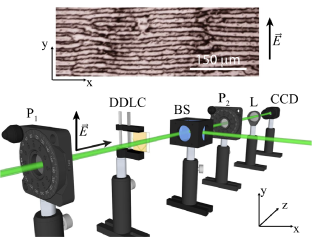
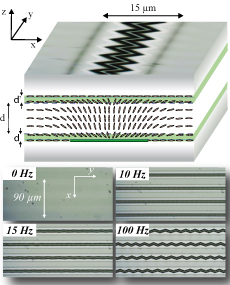
Zig-zag
wall lattice in a nematic liquid
crystal with an in-plane switching
configuration: Liquid
crystals displays with tailoring
electrodes exhibit complex
spatiotemporal dynamics when a large
voltage is applied. Experimental
observations exhibit the appearance of a
programmable zig-zag lattice using an
in-plane-switching cell filled with a
nematic liquid crystal. Applying a small
voltage to a wide range of frequencies,
the system exhibits an Ising wall
lattice. Increasing the voltage, this
lattice presents a spatial instability
generating an undulating wall lattice,
and to higher voltages it becomes
zig-zag type. Experimentally, we have
characterized the bifurcations and phase
diagram of the wall lattice.
Theoretically, we have developed, from
first principles, a phenomenological
model. This model has a good qualitative
agreement with experimental
observations.
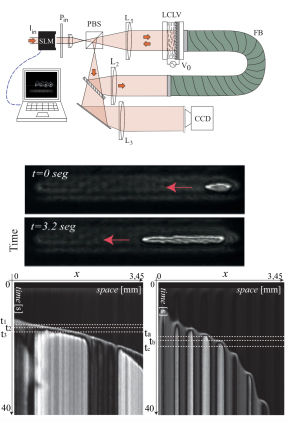
Front propagation into an unstable
state in a forced medium: Spatially forced systems
can exhibit coexistence and a rich interface dynamics
between manipulable states. We study how the propagation
speed of a front into an unstable state can be modified
through periodic space forcing. Based on optical feedback,
we set up a quasi-one-dimensional forced experiment
in a liquid-crystal cell. When changing the forcing
parameters, fronts exhibit a ratchet motion. Unexpectedly,
the average speed of fronts decreases when the strength
of the forcing increases. Close to molecular reorientation
transition, an amplitude equation allows characterizing
analytically and numerically the observed dynamics Nonvariational mechanism
of front propagation: In one-dimensional scalar
gradient systems, the spread of the fronts is proportional
to the energy difference between equilibria. Fronts
spreading proportionally to the energetic difference
between equilibria is a characteristic of one-dimensional
scalar gradient systems. Based on a simple nonvariational
bistable model, we show analytically and numerically
that the direction and speed of front propagation is
led by nonvariational dynamics. We provide experimental
evidence of nonvariational front propagation between
different molecular orientations in a quasi-one-dimensional
liquid- crystal light valve subjected to optical feedback.
Free diffraction length allows us to control the variational
or nonvariational nature of this system. Numerical simulations
of the phenomenological model have quite good agreement
with experimental observations.
The universal law of the front speed close to disappearance
of bistability. Multistable systems present rich
dynamical behaviors of interfaces between the different
equilibria. Close to the disappearance of bistability,
i.e., transition between a bistable to a monostable
region, we show that the speed of bistable fronts follows
a square root law as a function of the bifurcation parameter.
Analytically and numerically, we show this law for different
prototype models of bistable systems. Based on a liquid
crystal light valve experiment with optical feedback,
we investigate the front speed close to the disappearance
of bistability. Our results apply both to systems that
do or do not follow energy minimization principles.
Experimental findings show a quite fair agreement with
the theoretical results.
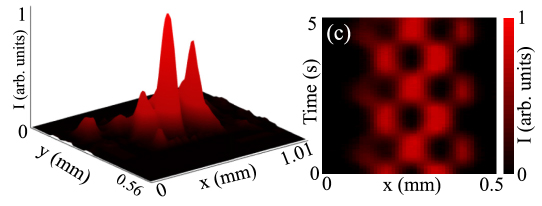
Localized standing waves induced by spatiotemporal
forcing: Particle-type solutions are observed in out-of-equilibrium
systems. These states can be motionless, oscillatory,
or propagative depending on the injection and dissipation
of energy.We investigate a family of localized standing
waves based on a liquid-crystal light valve with spatiotemporal
modulated optical feedback. These states are nonlinear
waves in which energy concentrates in a localized and
oscillatory manner. The organization of the family of
solutions is characterized as a function of the applied
voltage. Close to the reorientation transition, an amplitude
equation allows us to elucidate the origin of these localized
states and establish their bifurcation diagram. Theoretical
findings are in qualitative agreement with experimental
observations. Our results open the possibility of manipulating
localized states induced by light, which can be used to
expand and improve the storage and manipulation of information.
Asymmetric
counterpropagating front without
flow: Out-of-equilibrium
systems
exhibit domain walls between different
states. These walls, depending on the
type of connected states, can display
rich spatiotemporal dynamics. We
investigate the asymmetrical
counterpropagation of fronts in an
in-plane-switching cell filled with a
nematic liquid crystal.
Experimentally, we characterize the
different front shapes and propagation
speeds. These fronts present
dissimilar elastic deformations that
are responsible for their asymmetric
speeds. Theoretically, using a
phenomenological model, we describe
the observed dynamics with fair
agreements.
Harnessing
diffraction grating in an in-plane
switching cell submitted to zigzag
lattice: Programmable
diffraction gratings are relevant in
optical data processing. One of the
adequate device candidates is the in-plane
switching liquid crystal cell. This
technology, developed initially for liquid
crystal screens, has also been studied
with two inter-digital electrodes as a
diffraction grating. Recently, the
apparition of programmable zigzag wall
lattices in an in-plane switching
configuration has been reported. We show a
theoretical and experimental study of
programmable diffraction grating in an
in-plane switching cell.